
When Oregon Arrest Records Are Public
Oregon treats arrest records record by record. The Oregon Public Records Law covers ORS 192.311 through 192.478. It gives everyone the right to inspect records that public bodies hold, unless an exemption or another statute steps in. Writings, photographs, and electronic files all fall inside its scope. An agency can still redact details, withhold exempt material, or ask which record you want.
Booking photos follow a separate track. ORS 133.870 restricts law-enforcement release of these images even though the general law favors disclosure. It then carves out exceptions. A name, a booking date, a charge, and a photo can each carry a different access status. So name the record and its custodian first. A roster alone never shows everything.
Oregon Public Records and Arrest Limits
The public-records law reaches state and local public bodies alike. Requests go in writing under ORS 192.324 to the office that holds the record. Oregon's exemptions guard certain personal information, active investigations, and sensitive images. ORS 192.355 covers privacy and image protections. ORS 192.398 handles sealed records. A "public record" means a record tied to public business, not a promise of unredacted copies or unrestricted online display.
Different offices hold different pieces of an arrest. The county jail keeps the custody entry. Police hold the incident report. The court keeps filings and outcomes. One record can be open while another stays protected. A recent booking rarely shows a final outcome, since the court process runs separately. If a request gets denied, press the custodian for the decision, the legal basis for each withholding or redaction, and the review or appeal route. The Oregon Public Records Advocate's resources walk through request and dispute options.
Oregon Booking Photo Release Rules
Under ORS 133.870, a booking photo means an image law enforcement takes for identification when a person is booked into custody. That definition is narrow. A DOC profile, an old prison portrait, a court exhibit, or a media photo does not automatically qualify. A roster may show a name and date only. The statute governs what an agency may release; it never requires a booking record to carry a photo online.
Release is allowed in specific situations. The person depicted can request the image. So can another law-enforcement agency for its own work. The public may see one when the agency finds a law-enforcement purpose, such as locating a suspect or identifying other activity. Further exceptions cover a state mental hospital, a party or victim in the related case, a court for specified pretrial use, a licensed private investigator under ORS 703.430, and a conviction growing out of that arrest. Each is permission, not a command to publish.
The official Oregon Revised Statutes, chapter 133 place the agency-release rule in ORS 133.870 and the publisher-removal rule in the next section. The linked statute page shows the law's text, not a public photo feed.
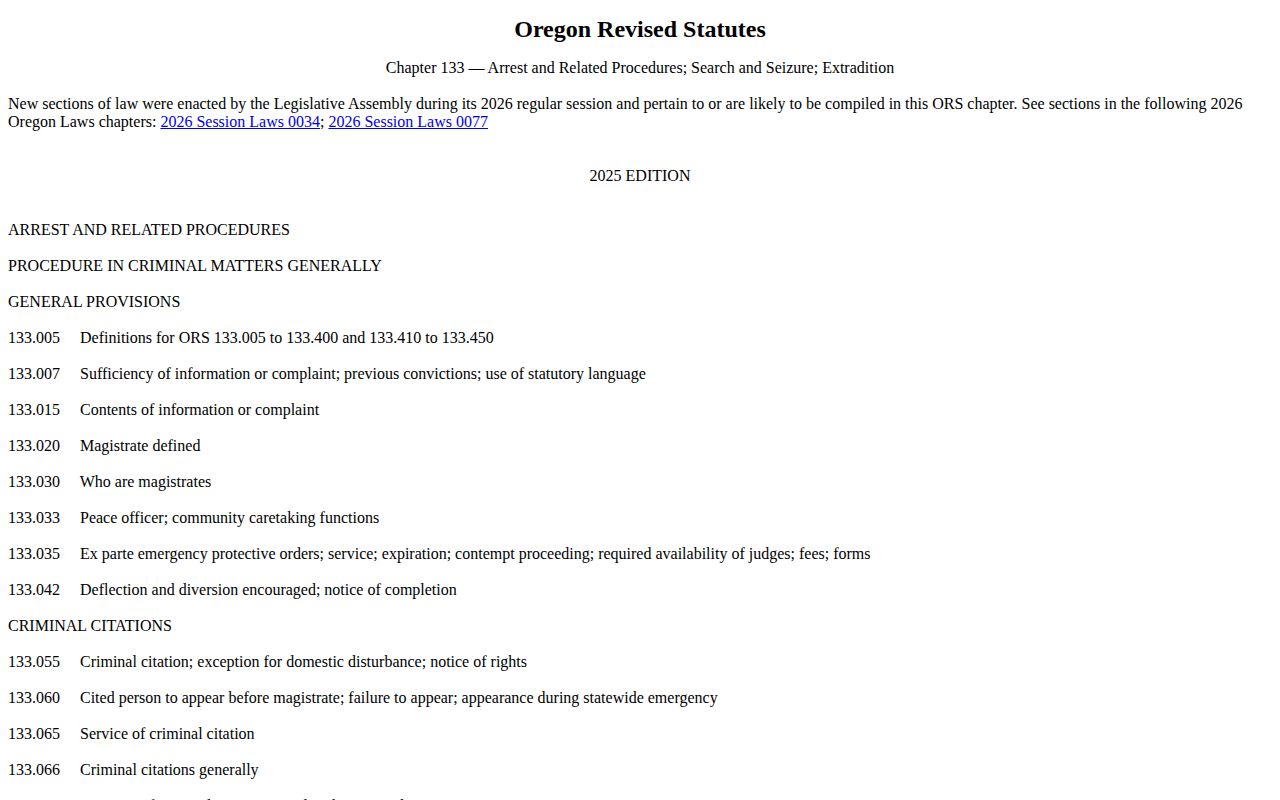
The image displays the state law source itself. It draws the line between an agency's narrow photo release and the separate rules for a publisher that posts a booking image.
Oregon Arrest Photo Law Changes
Oregon built this framework in 2021 through House Bill 3273, chapter 374. The bill tightened agency photo releases. It also created a removal process for a "publish-for-pay publication." That means a site that charges money or other consideration to delete a booking photo. The law took effect January 1, 2022. The official HB 3273 measure record documents it.
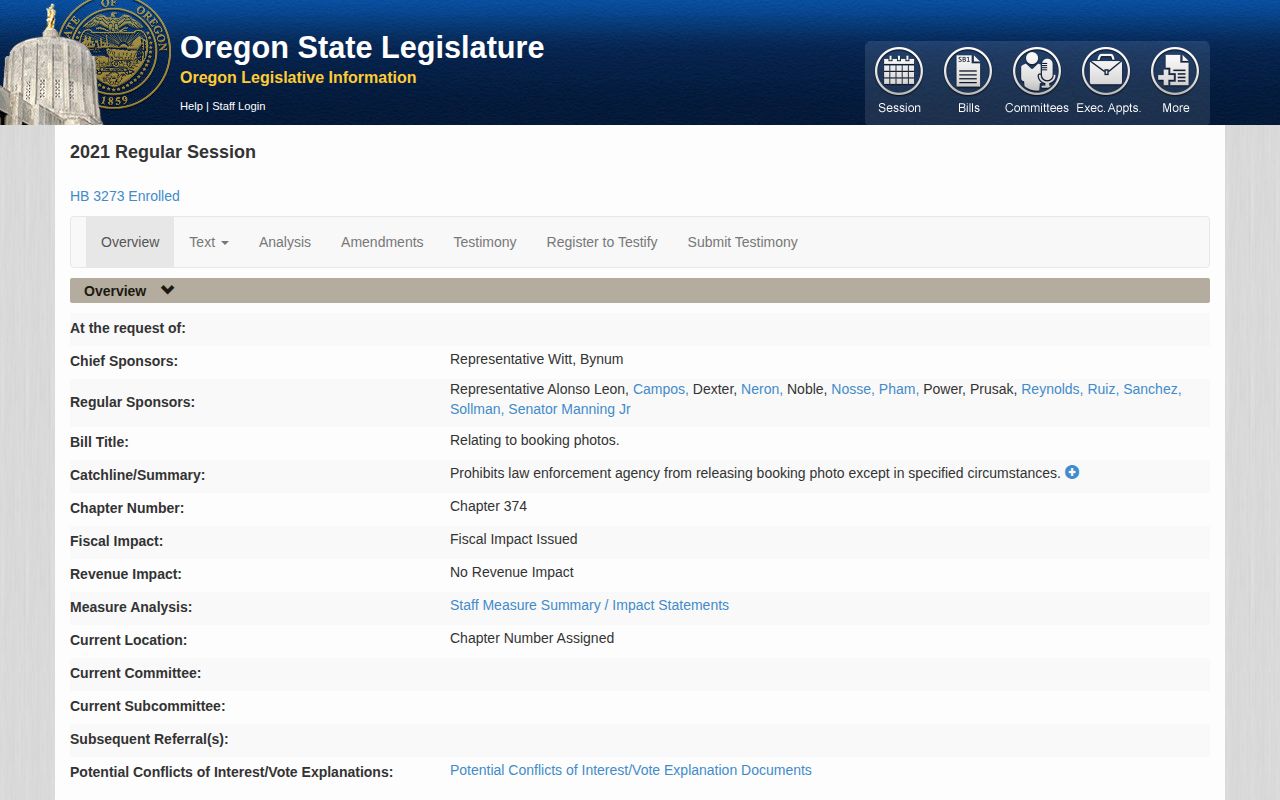
That 2021 law still anchors both removal tracks. Older summaries can miss a later amendment. Check the current statutory text before trusting any description of the agency exceptions.
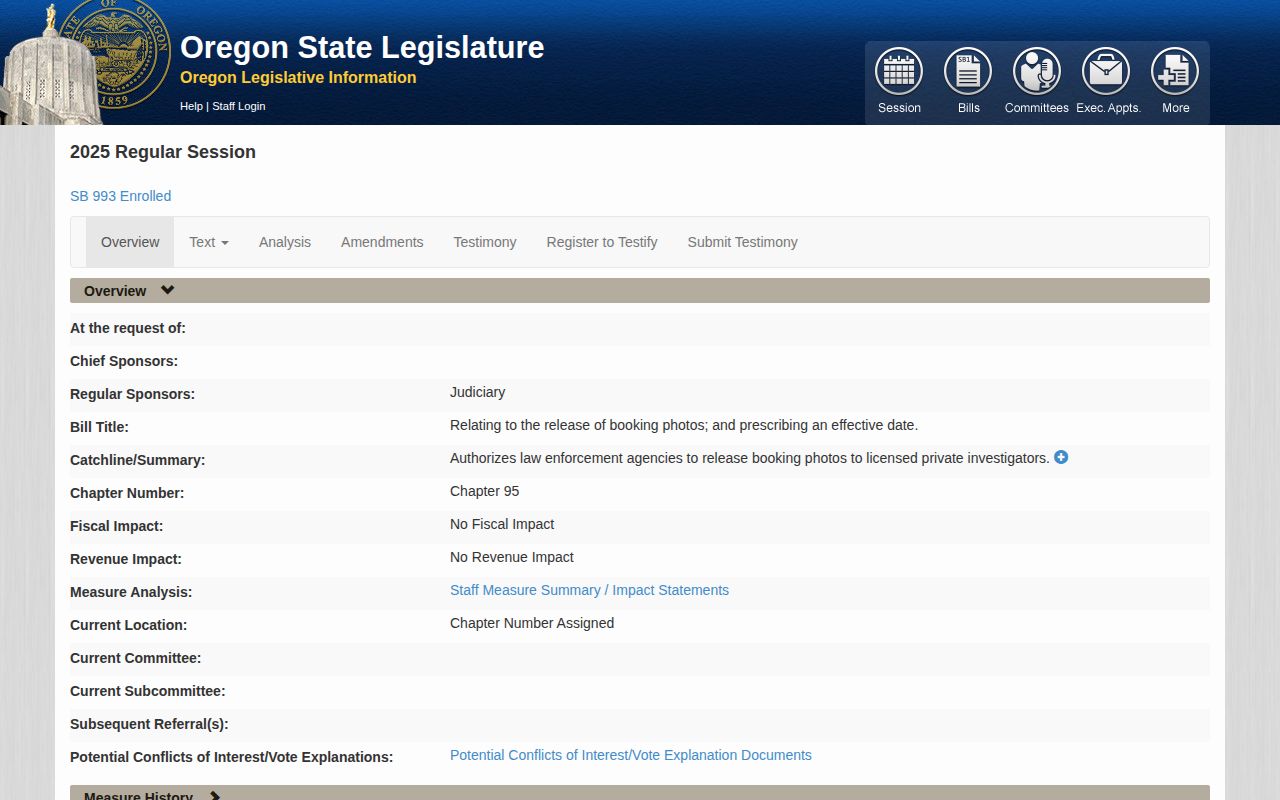
Then came 2025. Senate Bill 993, chapter 95, amended ORS 133.870 to add licensed private investigators as permitted recipients. It took effect on the 91st day after adjournment. The official SB 993 measure record documents the change, which left the other agency limits and the ORS 133.875 removal terms untouched.
No reported appellate decision has tested HB 3273 yet. None has interpreted ORS 133.870–133.875 either. That leaves the statute's meaning resting mainly on its own text, and a trial-level dispute or unpublished matter could still be working through the courts without public notice.
Oregon Arrest Lookup Routes
Tracking a recent Oregon arrest usually starts close to home. County custody pages show who is in a local jail right now. Their habits differ, though. Some skip booking photos. Some update slowly. Most drop an entry once a person is released. For state-level incidents, the Oregon State Police arrest page lays out that agency's channels. Neither route captures every arrest in Oregon. Two more sources fill out the picture. The Oregon Judicial Department case-search tools reveal filings and outcomes tied to a case. The Oregon Department of Corrections Offender Search tracks DOC custody and supervision rather than fresh county bookings. So the practical order is simple. Check the county custody page first for a new arrest, then the court record. The statewide photo landscape explains why image practices vary by county.
Oregon Records Requests and Appeals
Start by sending a written request to the office that actually holds the record. That means the county for a jail booking or sheriff report, OSP for its incident reports, the court for a disposition, and DOC for its custody records. If you guess wrong, ask the office where to send it instead.
Include a name if you have one. Add the date, place, record type, case number, and your preferred format. Ask for a cost estimate before work begins. ORS 192.324 and 192.329 set the response steps, including acknowledgment generally within five business days. Completion or status deadlines follow. Exceptions and practical processing needs can stretch the timeline.
- Choose the agency that created or keeps the record, then use its published request form or written-request address.
- Describe the record and date range, and ask the custodian to identify any fee before processing begins.
- If records are redacted or withheld, request the legal basis and the review or appeal steps for that agency.
OSP makes filing easy. Its Public Records Requests page offers online and downloadable forms. The first 30 minutes of staff time cost nothing. After that, rates climb to $25 an hour for clerical work, $40 for managerial, and $75 for professional tasks. Email delivery is free. OSP warns that some requests take 30 days or longer, and it will consider fee reductions under a public-interest test. County fee schedules look different, so check locally. A denial is not the end. Ask which exemption applies and what the review route is. The Public Records Advocate can help clarify next steps. A private roster site cannot decide an appeal about an official record.
Oregon Mugshot Removal Options
ORS 133.875 creates two tracks for publish-for-pay sites. The ordinary request and the favorable-disposition request carry different deadlines and fees. Your removal letter should include the page URL. It should also identify the image, state the outcome, and attach supporting documents. Note: this statute does not erase an old county record or replace a court order.
| Request track | Current statutory rule |
|---|---|
| Ordinary request | Remove and destroy the booking photo within 30 calendar days. A fee may be charged, capped at $50. |
| Documented favorable outcome | For acquittal, no prosecution, a conviction set aside or vacated, or a pardon, remove and destroy it within 7 days. No fee or other consideration may be required. |
Deadlines matter here. Miss one and a publisher can owe costs, reasonable attorney fees, and statutory damages. The rate is $500 per day after the ordinary deadline, or $1,000 per day after the favorable-disposition deadline. There is teeth in the law too. Charging for a qualifying favorable removal may be prosecuted as theft by deception. ORS 646A.806 is a separate statute. It targets websites that charge to remove arrest photos and the names or personal details attached to them. A written request must be honored free within 30 days. The backing must be court or law-enforcement records showing acquittal, no conviction, reduction to violations, or an expunged or set-aside conviction. For exact scope, read the current ORS chapter 646A text. Some private publishers also offer no-charge request paths. RecentlyBooked's policy covers specified inaccurate, outdated, sealed, expunged, restricted, duplicate, juvenile, and other records. Its Oregon coverage is partial and may change. Requests there call for the page URL, identifying details, county and date, reason, and documents. Busted Newspaper's form asks for a valid post URL and proof. It charges no fee. It says a request may take five to ten days, but that is not a legal guarantee. Mugshots.com's policy describes no-charge maintenance or removal. This covers documented sealed, expunged, restricted, no-information, identity-theft, death, or favorable-disposition records. Its processing may take up to ten business days. These are unofficial publisher rules, not Oregon agency records. Work from the source. Correct the record with its custodian first, then contact each publisher separately. Treat any promise to erase every copy, court entry, and search result for a fee as a warning sign. Use the agency, court, or publisher's own process.
Adult Set-Asides and Arrest Records
Oregon's adult remedy is called a set-aside, though many people say expungement. A court can seal records by order. The authority is ORS 137.225, covering eligible arrest, charge, and case records. Eligibility turns on several things. The offense type and the outcome both factor in. So do a completed sentence and supervision, restitution and fines, later convictions, open charges, and statutory exceptions. One caution applies. An order does not erase every copy held outside the court. Waiting periods differ by offense class. They may run from the later applicable conviction or release point. Dates shift case by case. Treat any chart as a starting point, not an eligibility ruling.
| Outcome or offense type | Common statutory timing |
|---|---|
| Class B felony | 7 years |
| Class C felony and specified person-crime or contempt categories | 5 years |
| Class A misdemeanor | 3 years |
| Class B or C misdemeanor, violation, or other contempt category | 1 year |
| Not prosecuted | A route may open after the prosecutor indicates no prosecution and the statutory 60-day period passes |
Not every case waits. An acquittal or dismissal can be addressed after the qualifying outcome. The conviction waiting period does not apply. Revocation and similar cases follow separate rules. A prosecutor may object. The court decides eligibility in the end, and the current ORS 137.225 text controls. Expect possible filing-fee treatment and state-police fingerprint or history costs. A court order changes only the official record it covers. It is no promise of destruction. A private copy, old county document, search-engine image, or screenshot may still exist. The practical path: send the order to each relevant custodian and publisher. Then make a separate stale-result request after the source page changes.
Oregon Juvenile Record Limits
Youth records sit behind their own wall. Oregon handles them apart from adult arrest records. ORS 419A.250 and 419A.255 restrict juvenile court files and juvenile department records. Access depends on who asks and on court authority. Photographs and fingerprints can be swept into a juvenile expunction order under ORS 419A.260 through 419A.271. Eligibility varies. Age, time since the case closed, later conduct, open matters, and record type all play a part. These files are not a public booking source. Never identify a minor from a roster, and never assume a similar adult name belongs to a youth. Questions belong with the court or the juvenile records custodian, guided by the current Oregon statutes in chapter 419A. No statewide overview can promise any individual's expunction outcome.
Oregon Stale Arrest Copies
Sealing a record does not erase every copy. Old versions linger. A county document, a publisher's page, a saved screenshot, a search snippet, and a cached thumbnail can each survive on its own. Send the order to the originating custodian first. Then contact each publisher holding a copy. Track every request and each response. When the source page changes or vanishes, a stale snippet or thumbnail may still show up in results. Google offers an outdated-content refresh process for exactly that problem. It updates the search listing, not the official record, and no statewide mechanism deletes every old copy on its own.