
Oregon Arrest Records Beyond Custody
An Oregon arrest log is a stack of dated events, not a running view of who sits in jail right now. One county press log describes an incident. A sheriff release summarizes an arrest. A jail roster may show someone booked on an older warrant. Searching across several days can surface a dated report that has dropped off the current-custody page. Even so, none of it adds up to a statewide arrest list. Keep three dates straight. These are when the event happened, when the booking occurred, and when the item was published. They rarely match. A log can also list a citation. So can a warrant service with no jail booking attached.
Where Oregon Arrest Logs Appear
Official county material is the right first stop for a source record. Oregon never settled on one format or window. Some agencies post dated press logs. Some publish daily incident material. Others run a jail-vendor roster that is current rather than historical. The county directory routes readers to local sheriff and jail sources. Regional systems need an extra check. Custody can cross county lines. Baker County's CAD Press Log Archives and Deschutes County's dated incident PDFs show two county publication styles side by side. A custody vendor may list only the people held when its data refreshes, so an absent date proves nothing about whether an event occurred or how complete the archive is.
| Publication type | Oregon example | How to read it |
|---|---|---|
| CAD or press log archive | Baker County CAD Press Log Archives | Dated incident or press documents; not a jail custody roster. |
| Date-range arrest query | Umatilla County arrests search | Searches a 30-day period; it is not a permanent statewide archive. |
| Daily incident material | Deschutes County dated incident PDFs documented in its county research | Keep the publication date and report scope; the public archive is not necessarily a full arrest history. |
| State police releases | Oregon State Police newsroom | Selective, dated incident stories rather than a statewide daily log. |
| Regional custody page | NORCOR adults in custody | Current regional custody data; it may not preserve earlier bookings as a blotter. |
| Local newsroom reporting | Oregonian, OPB, KGW, KOIN, KATU, KTVZ, KOBI/NBC5, KTVL, KEZI, KVAL/KPIC, KDRV, The Bulletin, Statesman Journal, East Oregonian, and The Register-Guard | Secondary reports can add context but are not official custody systems. |
The Baker County archive page lists dated press-log files.
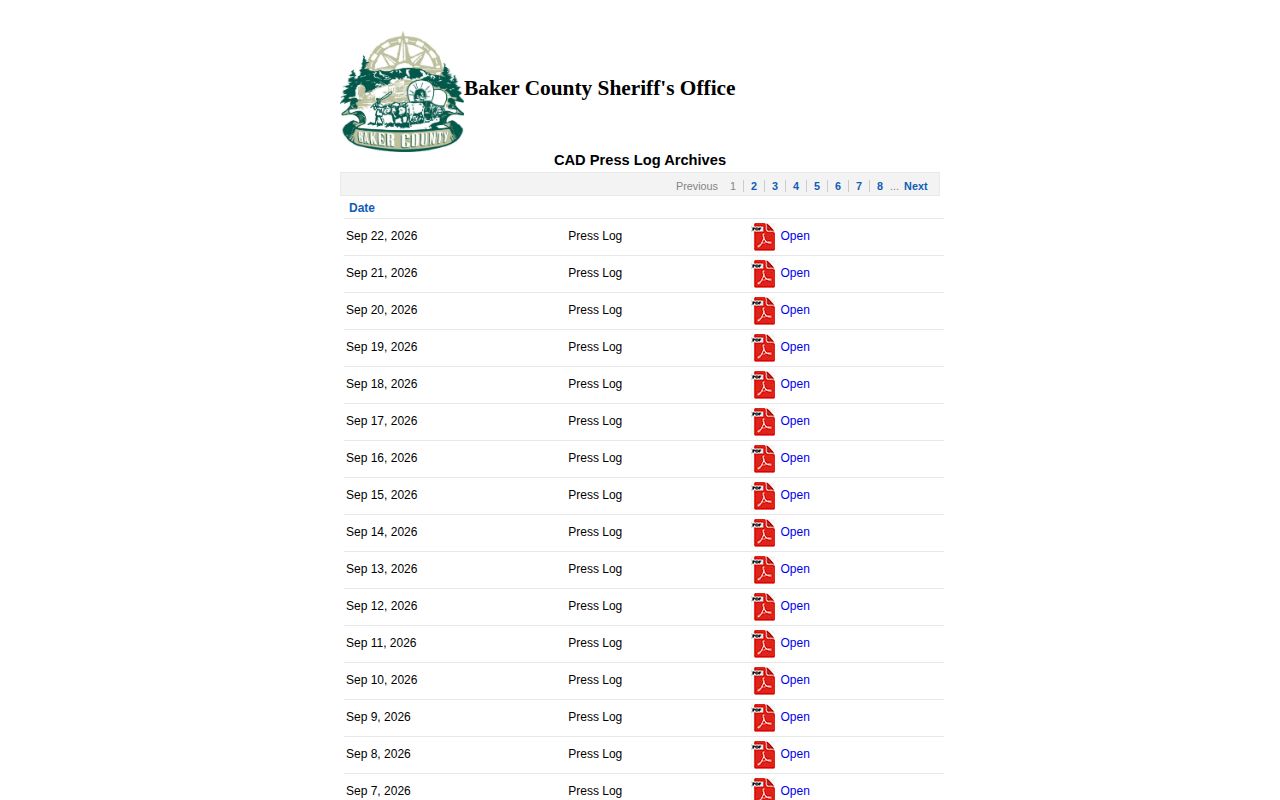
Preserve the dates searched. A press-log file may document an incident while never showing whether anyone was booked or remains in custody.
Note: A county log's available dates describe that source's archive, not every arrest made across Oregon.
Fields in Oregon Arrest Reports
What a record shows depends on its source. An Oregon State Police incident release may list the agency, the location, the arrest action, and where the person was booked. Some releases include a photo too. A roster works differently, showing a booking date and current custody status. Read each label, and leave blanks alone.
| Field when provided | What it describes | Limit |
|---|---|---|
| Incident or event date | When the reported event took place. | It may differ from publication or booking date. |
| Agency and location | Which office handled or reported the event and its stated location. | The agency that published a story may not hold the jail record. |
| Arrest action or charge | The action and alleged offense described by that source. | It is not a court finding; preserve the source's wording. |
| Booking destination | A jail named in a release as the place a person was lodged. | It reflects the reported destination, not necessarily present custody. |
| Publication date | When the report or release was made public. | It may differ from both the event date and booking date. |
| Photo or image link | An image made available by that source. | Not all agencies release booking photos, and an image is not a disposition. |
A blank field can mean several things. The source may skip the detail. Or the record ran incomplete. Or the information was withheld. The Oregon Judicial Department's Find a Case or Court Record page links basic searches, calendars, OJCIN access, and courthouse terminals.
Booking Versus Oregon Arrest Logs
A log entry and a booking answer different questions. A log can report a police incident, a citation, or a warrant service with no jail intake at all. A current custody roster can show someone booked on a warrant tied to an earlier event. So check the wording. If a dated blotter says "arrest," confirm the source also says the person was booked. Not every line is a jail admission. NORCOR's public view shows booking dates and charges. Bail and scheduled-release information may appear too. It is a current custody view, not a permanent event archive or a complete list of all arrests there. The NORCOR adults-in-custody page shows a roster layout rather than a dated press log.
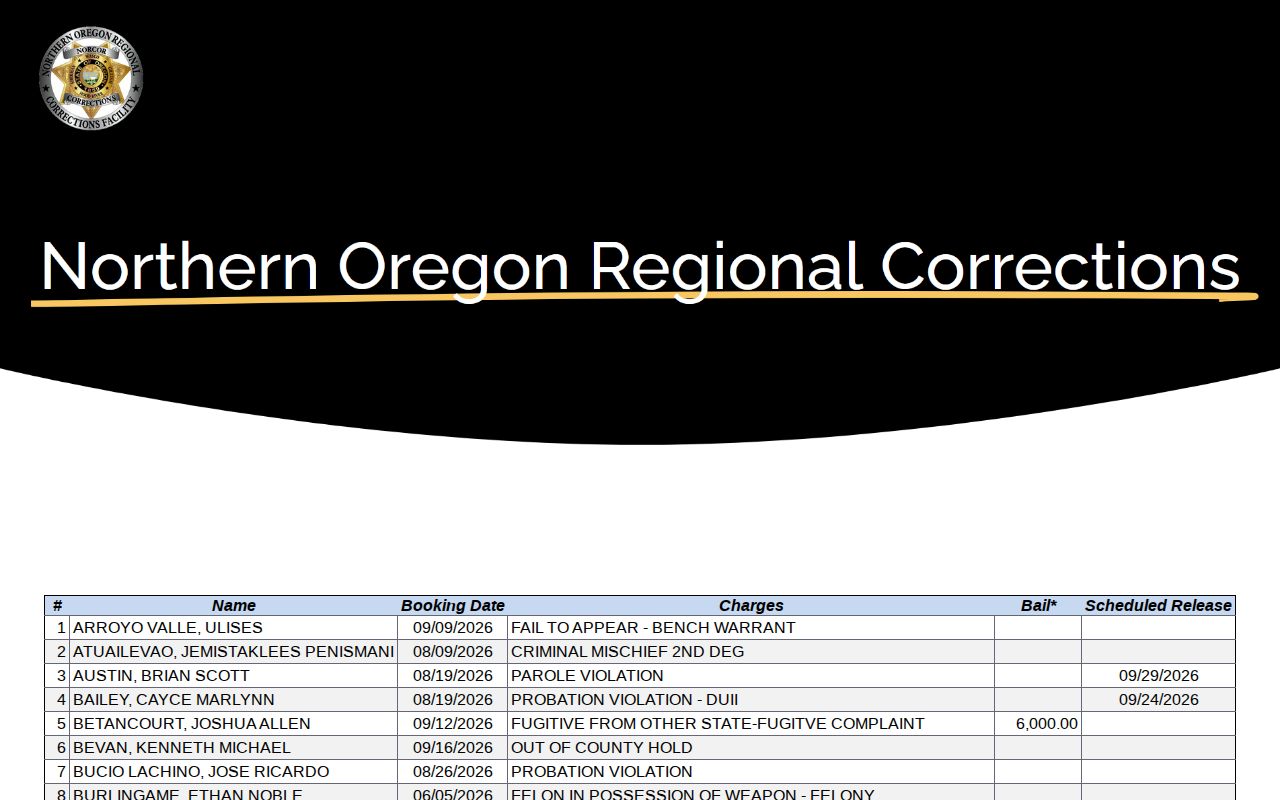
NORCOR serves Gilliam, Hood River, Sherman, Wasco, and Wheeler. The Morrow/Umatilla and Union/Wallowa arrangements also explain why the arrest county and the booking county may differ, so follow the named custodian.
Weekend and Holiday Oregon Arrest Logs
Weekends and holidays shift when a log gets reviewed or posted. A newsroom and a sheriff's office keep different schedules. A jail vendor may wait for a finished intake. A gap like that reflects cadence or delay, not a drop in arrests. Hold onto two dates: the original event date and the date the entry went public. Need to know who is in custody right now? A current roster beats a multi-day archive. The same-day paths sit on Oregon's Arrested Today page. That view has its own limits when an intake is new or a person was already released.
Note: Weekend posting gaps reflect a source's schedule and available window, not a count of all Oregon arrest activity.
OSP Arrest Data and Named Bookings
Oregon State Police releases are selective, dated accounts. The agency posts no statewide daily arrest log. A FlashAlert or news item may report an incident, the arrest action, and the county booking destination. It is not the county jail's custody record.
ODOT's September 2025 report on DUII enforcement covers 16 operational periods across 28 counties, with about 174 criminal arrests. The Oregon FFY 2024 highway-safety report tracks patrol hours, stops, DUII arrests, citations, and warnings. Both are aggregate program measures. Names do not appear in them.
Start with a dated OSP release, then follow the booking destination it names. The county and state reports have separate custodians.
Oregon News Blotters as Secondary Sources
Oregonian and OregonLive, OPB, KGW, KOIN, KATU, KTVZ, KOBI/NBC5, KTVL, KEZI, KVAL/KPIC, KDRV, The Bulletin, Statesman Journal, East Oregonian, and The Register-Guard appear in county research as cross-county or regional public-safety sources. Their stories add editorial context, not a statewide booking database.
A newsroom correction does not change an agency record or guarantee removal of an accurate story. Free contact routes include the Oregonian Media Group newsroom and OPB's submit-an-idea page. Ask the newsroom about an article error and the originating agency about a booking detail.
Archives for Older Oregon Arrest Records
Jail systems keep a short live view. Historical county registers travel a different road. The Oregon State Archives inventories prisoner registers through 1965, when newer jail registers stopped offering much informational value. A surviving series may hold an entry date, name, physical description, arrest date, officer, crime, sentence, bail, court, release date, or remarks. No series promises every field. Photos are rare in these old registers.
Access has a legal gate. County records close for 25 years after custody ends under ORS 192.496(3). Old registers may sit with a county office, historical society, library, archive, or museum. Each keeper sets its own rules. Historical penitentiary files count as corrections records, not a live jail feed, and the DOC retention schedule promises neither public display nor digitization.
Start with three Archives tools. The Historical County Records Guide, the Oregon Historical Records Index, and the Archives' records page map what survives. Give reference staff a name, an approximate date, the county or institution, and the record type. Ask about access, copy costs, and timing before ordering.
For a recent booking past the log's window, contact the sheriff, jail custodian, or clerk; the court holds the case outcome, and a missing archive entry never proves an arrest didn't happen.
Note: An archived register, a current jail roster, and a news story are separate record series with different custodians and access rules.
How to Trace an Oregon Arrest Log
Work from dated sources in order. That keeps an event report from being mistaken for present custody. The Oregon County Directory routes you to local agency and jail pages once you know the county.
- Set the event window. Note the approximate date and place, and whether the question concerns an incident, a booking, current custody, or a court case.
- Choose the record maker. Start with the county sheriff or city agency for local events; use the OSP newsroom for a state-police incident; check a regional jail when the county shares custody.
- Record the source date and range. A dated PDF, archive list, and current roster can have different update rules. Save the date printed by the source.
- Follow the booking destination. If a release names a jail, check that custodian for intake and current status rather than treating the release as the roster.
- Use the court for later outcomes. Search the case or ask the clerk if the online portal lacks a match. A case may not yet be filed or may be restricted.
Archives run out eventually. Ask the agency that created the report for the date range, location, event, and record type, and request a fee estimate. The court still owns the case outcome.