
Oregon State Police Arrest Authority
Oregon State Police serves as the state's patrol agency. Its Field Operations Bureau splits work across Northwest, Central, Southwest, and East regions. Northern and Southern command centers back them and handle dispatch. Troopers watch state highways and run both traffic and criminal enforcement. That work can end in an arrest, a citation, warrant service, or an incident report. Not every event produces a jail booking, though. The agency's About OSP page and organization overview lay out its role and structure.
A news item from OSP covers an event the agency chose to announce. It is not a roster of everyone arrested on Oregon roads. A release may name an alleged offense and the spot. It can also list the arresting unit and where the person was booked. Others cover a citation or crash response with no jail stay at all. Read each one for what it says.
The regional setup explains the local paper trail. A trooper can arrest someone far from any city. The trooper then drives the person to a county jail. That county, not OSP, keeps the booking record. Anyone tracking a person in custody should pin down the booking county. Only then should they try a roster.
Where OSP Arrest News Appears
The agency's official newsroom is the best public starting point. OSP pushes releases through FlashAlert. Anyone can subscribe to updates. Posts carry dates. They are chosen items. They form no live custody screen. OSP's public site offers no statewide daily CAD, dispatch, or arrest log. Its command centers do not publish an activity feed. The newsroom is an announcement outlet, not a complete record of Oregon arrests.
The newsroom page explains how releases go out and links the agency's official channels. Use it for incident reports, then confirm custody through the county a release names. Open Oregon State Police News Releases for dated official posts and subscription links.
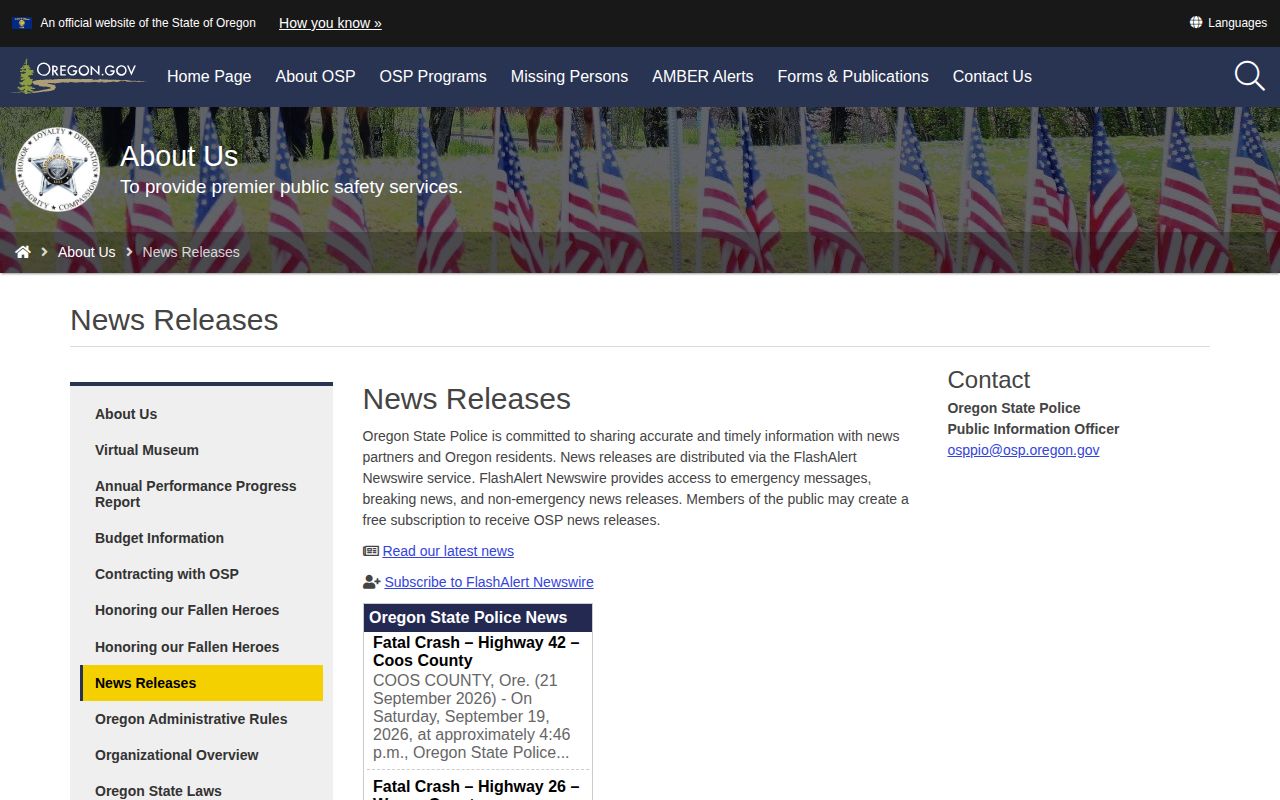
A newsroom item adds context to an arrest story. It still cannot replace the booking entry or the court's later case record.
| OSP publication | What it can show | What it does not establish |
|---|---|---|
| News releases | Selected dated arrests, incidents, and agency statements. | A complete list of arrests or current custody. |
| FlashAlert OSP Oregon | Agency releases and optional email notices. | A public daily CAD or jail roster. |
| OSP social channels | Selected notices linked by the newsroom. | The official booking record, full case file, or court result. |
| ODOT and DUII enforcement reports | Aggregate patrol activity, stops, arrests, citations, and warnings. | Named bookings or convictions. |
FlashAlert is the channel the newsroom uses to distribute posts. Its OSP channel shows the release stream. It is not an arrest search. Visit the official OSP FlashAlert channel to view current posts.
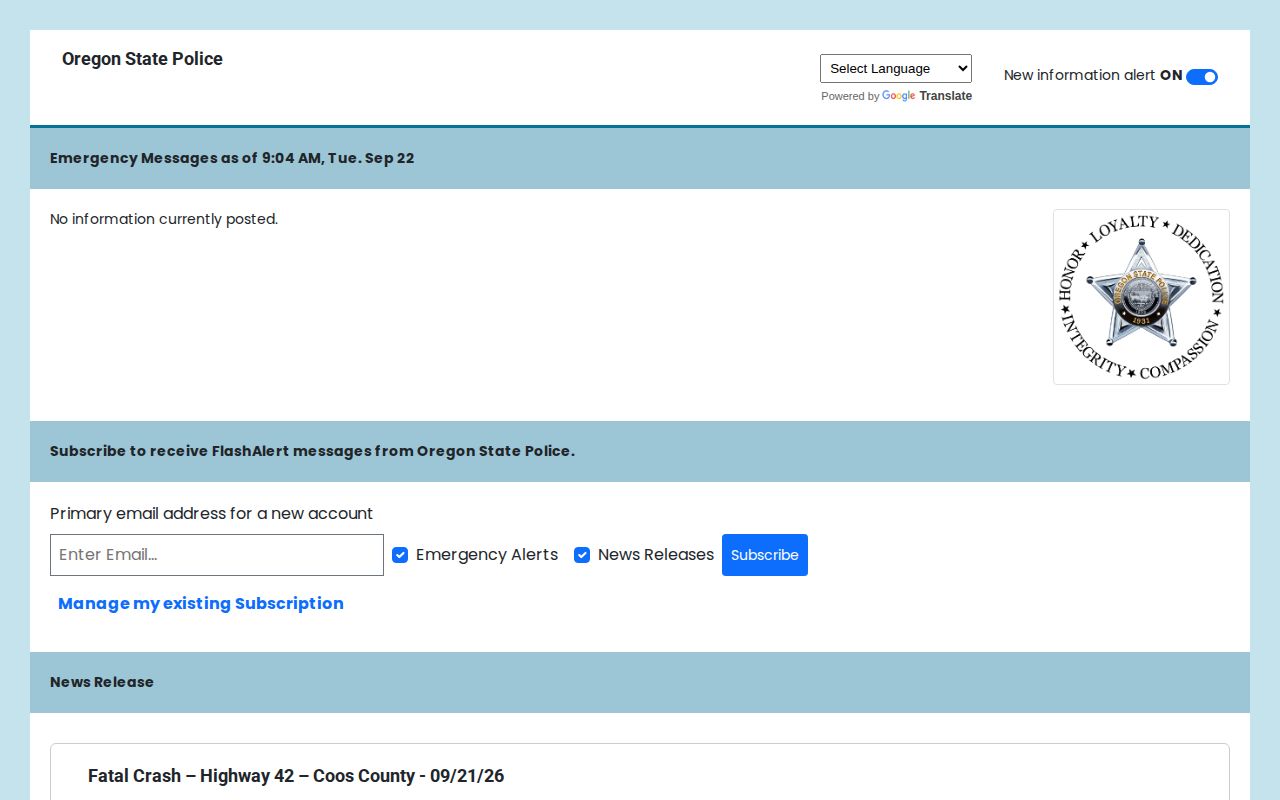
A free subscription delivers selected news to your inbox. An alert still does not confirm that a person remains in custody.
Find an OSP Arrest Record
Searching for a named arrest means splitting the story from the record. A release may point to a county jail. Yet OSP's public channels never show every arrest or each person's custody status. Silence is not proof. An arrest can happen without any news item following it. Take the county named by the agency as the next official source. Request the OSP report when the record itself matters.
- Search the OSP newsroom and FlashAlert by the incident date, county, road, or agency language. Keep the release date separate from the event date.
- Read the release for a named booking destination. If a county jail is listed, use the Oregon County Directory to reach the county's roster or records route.
- Check the jail's current custody view for present status. A person can be booked and then released before the next search, so a missing roster entry does not disprove the earlier event. The statewide Arrested Today page explains the county same-day routes.
- Use a court search for filed charges and disposition. If the OSP event report is needed, submit a request to the agency's Central Records Section.
County records matter. Local jails log bookings even when OSP made the arrest. One official OSP release said a person was lodged at Clackamas County Jail. Another described an event in Marion County. Those examples show the booking destination rule, not a statewide list of OSP bookings.
Where OSP Arrestees Are Booked
Oregon State Police runs no jail system. A trooper arrest that needs custody ends at a county jail. Whichever jail accepts the person becomes the destination. That county's roster or booking system holds the current custody entry. Its records office handles booking record or photo requests. People get released, moved, or transferred. Any roster result is just a snapshot.
One OSP release involving Clackamas County names the county jail as the lodging spot. Another OSP release involving Marion County shows the same county handoff. When a release names a destination, use the county directory. Do not hunt for an "OSP jail" that does not exist.
A booking entry marks two facts: an arrest and a stretch in custody. After release the county roster entry may drop away, but the arrest report and the court record still exist.
After a state prison sentence or during state supervision, a different trail opens. Use the Oregon DOC Offender Search for that. It is not a same-day county booking source.
Request an OSP Arrest Report
OSP handles its own paperwork. Arrest, incident, and crash reports from the agency start at the Public Records Requests page, which posts a downloadable form and explains the Central Records Section's route. County jail bookings are different. Those belong with the county custodian, not OSP. Name the record you want. One blanket request will not pull every file each agency holds. Before mailing anything, check OSP's request instructions and current contacts. The request screen asks that a completed form describe the record as precisely as possible, so spell out what you need.
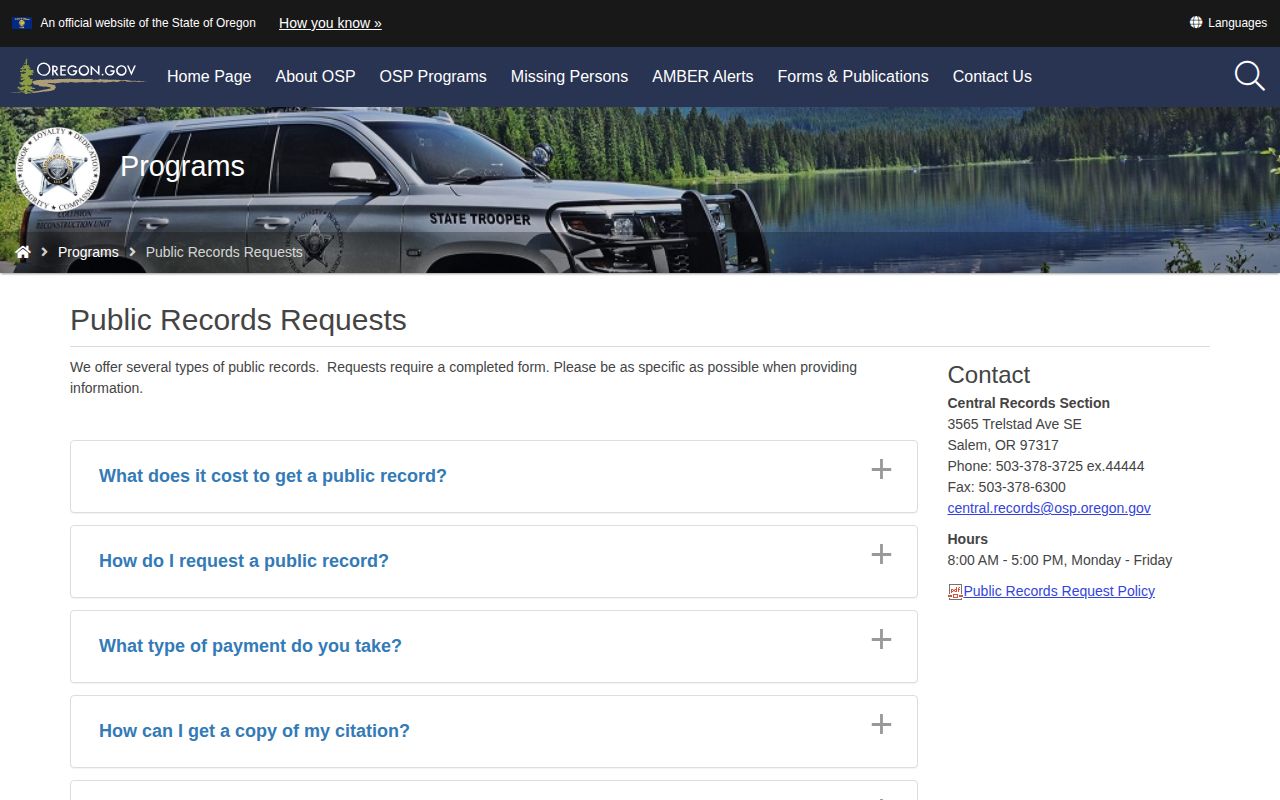
OSP can redact or withhold material under a legal exemption. That includes open-investigation details, child-abuse information, and protected personal or medical data.
- Describe the event, date, county, report type, and case number if known. Say whether an electronic copy is preferred.
- Submit the agency's form or use the instructions on its request page. A request can be filed before payment; OSP says it will send a letter if a fee is required.
- Ask for a fee estimate and state why a public-interest reduction may apply, if relevant. The first 30 minutes of staff time are listed without charge.
- Review the agency's response and any stated redaction or exemption. OSP warns that some requests take 30 days or longer depending on the record and workload.
After the first 30 minutes, OSP lists hourly rates. Clerical work runs $25 per hour. Managerial work runs $40, and professional work runs $75. Media and other actual costs may apply. Those rates are OSP's alone. County jails set their own fees. The agency can also waive or reduce a fee on public-interest grounds.
Oregon's Public Records Law governs the process, but exemptions still apply. A response might deliver the report or explain a delay. It could also redact protected parts or cite a reason for withholding. For a filed case and its disposition, the circuit court is the place to check.
Oregon DUII Arrest Results
OSP and partner agencies publish enforcement totals, not a full list of who was arrested. The numbers give a sense of scale. They name no one. The September 2025 DUII High Visibility Enforcement report is a good example. It covers 16 operational periods across 28 counties and roughly 174 criminal arrests. Those totals apply only to the stated report period. Read the September 2025 DUII report for activity spread across multiple jurisdictions. A separate FFY 2024 highway safety report adds dedicated impaired-driving patrol hours, stops, DUII arrests, citations, and warnings. Be careful mixing those columns. A stop, a warning, a citation, and an arrest are different outcomes, and the totals should never be added together as one measure. The Patrol Services page outlines OSP's highway safety and crime-reduction work, with regions and command centers coordinating coverage. Still, a program result is not a searchable arrest log. For one incident, use a dated release; for custody, use the county booking source. Recent OSP news may surface through its newsroom and FlashAlert, but there is no public daily statewide activity log. A dated publication can pin down the county, time, and reported event, though it cannot fill every gap in a local roster. A multi-day arrest report helps with published incidents, yet it is no substitute for the booking custodian's record.
OSP Regions and Arrest Coverage
OSP splits field operations into Northwest, Central, Southwest, and East regions. Northern and Southern command centers support dispatch. The agency publishes a map of command-center coverage. A region is an operational structure, not a jail or a public arrest database. Use the location and unit references in a release to follow up with OSP directly. Any custody question goes to the county named as the booking destination.
The command-center page shows dispatch coverage, while Patrol Services covers highway enforcement. Both pages can show which part of OSP handled a matter. Neither lists who was arrested in a region.
Official social accounts carry selected notices. They are communication channels, not the source record. Follow a post back to the newsroom when possible. Use the report-request route for the underlying OSP file. County jail records and court dockets answer different questions. Check them separately.
- CAD
- Computer-aided dispatch, the system used to route calls and field units. OSP does not publish a statewide public daily CAD log.
- DUII
- Driving under the influence of intoxicants, Oregon's term used in the enforcement reports cited here.
- Disposition
- The court's recorded outcome for a charge or case, which may differ from the charge in an arrest release.
Oregon Arrest Records After Booking
Oregon keeps its records in layers. OSP creates incident reports and news releases. The receiving county holds the jail booking record. The Oregon Judicial Department holds public case entries and disposition data. DOC holds custody and supervision records once a person enters the state system. Each layer appears at a different time. Protected or juvenile information may be withheld along the way.
Search the court record after locating the case. Contact the clerk or records custodian when an online result is absent. Someone no longer in county custody may still have a booking record. Ask the county, even if a live roster no longer displays it.
An OSP release does not replace the court's disposition or a county's photo policy. Oregon's booking-photo statute limits what agencies may release. A mugshot can be withheld even when the arrest report itself is public. Send any image request to the agency that created it. Ask for the legal basis if access is denied.